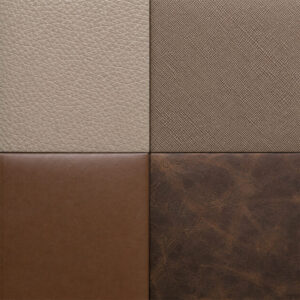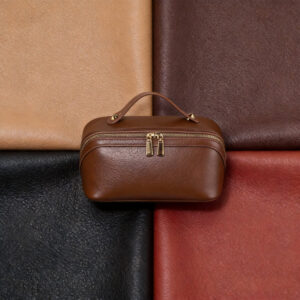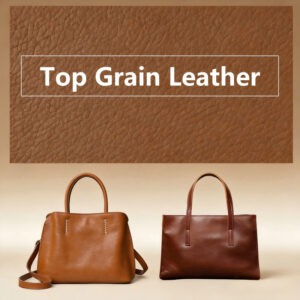
When customizing leather bags, the choice of leather material directly affects the product’s feel, durability, and brand value. Top-grain leather and split leather are the two most common options, yet many B2B buyers still misunderstand the fundamental differences between them. This article explains their distinctions in terms of leather structure, physical performance, cost, and application scenarios to help you make more informed sourcing decisions.
1. Understanding How Leather Is Split
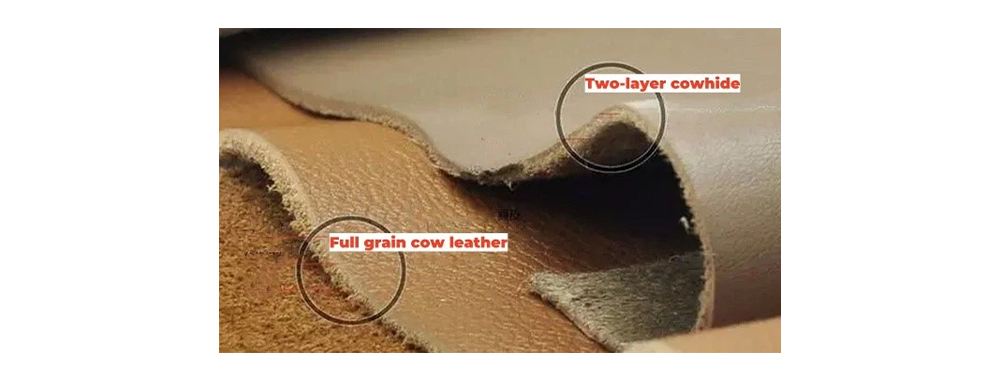
A cowhide consists of three main layers: the grain layer, the corium, and the flesh layer. During the tanning process, a full hide is typically split into multiple layers, giving rise to what we know as top-grain leather and split leather.
Top-Grain Leather (Top-Grain / Full-Grain Leather)
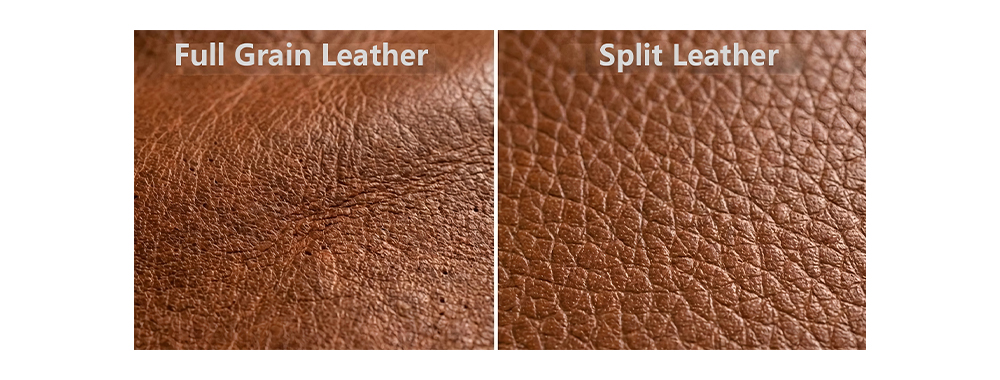
Top-grain leather retains the cowhide’s natural grain surface, where the fiber structure is the densest and strongest. The natural pores, grain patterns, growth marks, and even minor scars remain visible, giving each piece a unique appearance. As the outermost and most durable layer of the hide, top-grain leather is widely recognized as the highest-quality grade of genuine leather.
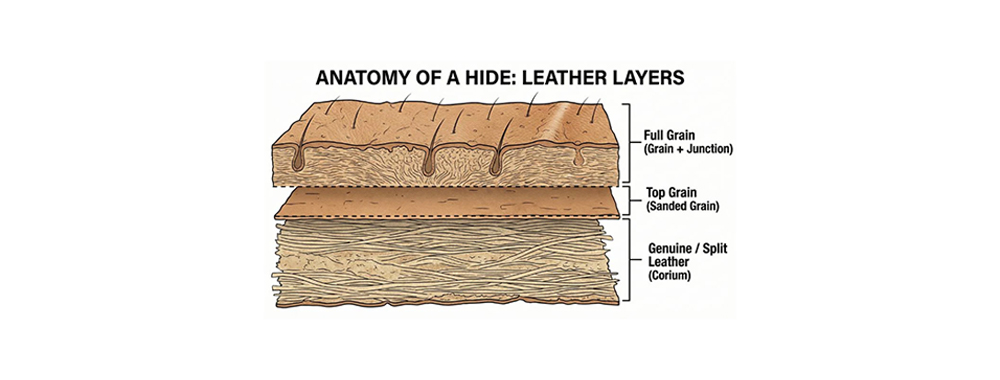
Split Leather (Split Leather / Genuine Leather)
Split leather is the layer that remains after the top-grain layer has been separated from the hide. Compared with top-grain leather, its fiber structure is looser and it lacks the natural grain surface. To achieve an appearance similar to top-grain leather, split leather is typically finished with a polyurethane (PU) coating or embossing, creating a more uniform texture and surface pattern.
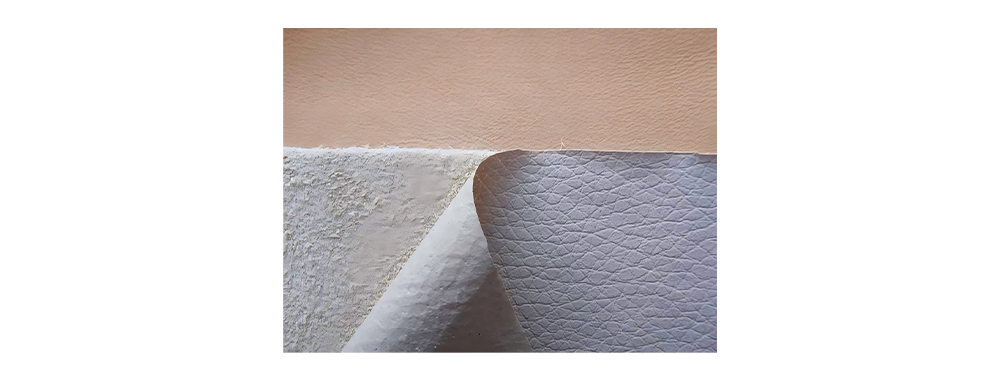
2. A Comprehensive Comparison Across Six Key Dimensions
| Comparison Criteria | Top-Grain Leather | Split Leather |
| Fiber Structure | Retains the natural grain layer with tightly interwoven fibers | Lacks the natural grain layer; fibers are relatively loose |
| Surface Texture | Natural pores, grain patterns, and growth marks; every hide is unique | Artificially embossed or coated for a uniform, consistent appearance |
| Touch & Feel | Soft, supple, and full-bodied; develops a richer patina and becomes smoother over time | Generally stiffer or thinner, with a slightly plastic-like feel |
| Durability & Strength | Excellent tear resistance and flex durability; can last over 10 years with proper care | Approximately 60–70% the strength of top-grain leather; more prone to cracking at flex points |
| Breathability | Naturally breathable and moisture-absorbent due to open pores | Breathability is significantly reduced after coating or lamination |
| Price Range | Typically costs 2–4 times more than split leather | Offers a clear cost advantage and excellent value for budget-conscious projects |
3. Appearance & Feel: How to Tell the Difference with the Naked Eye
Characteristics of Top-Grain Leather
- Irregular grain patterns: Natural scars, insect bite marks, and growth lines are visible, making each hide unique rather than perfectly symmetrical.
- Color change under pressure: When gently pressed with a finger, the compressed area may temporarily become lighter in color (known as the aniline effect) and return to its original color once the pressure is released.
- Edge cross-section: The cut edge reveals natural fibrous strands instead of a smooth, uniform, plastic-like appearance.
Characteristics of Split Leather
- Overly uniform texture: The embossed grain pattern is highly repetitive and lacks the natural variations found in genuine grain leather.
- Noticeable coated surface: The finish often appears as though it has a layer of varnish or film, resulting in a relatively rigid or artificial-looking gloss.
- Smooth, even edges: After coating or lamination, the cut edge appears smoother, and in some cases, the layered structure of the leather may be visible.
4. Durability: Why Does Top-Grain Leather Look Better with Age?
The durability of top-grain leather goes beyond its superior tear resistance. Its real advantages lie in its repairability and its ability to develop a beautiful patina over time.
Flex Resistance:
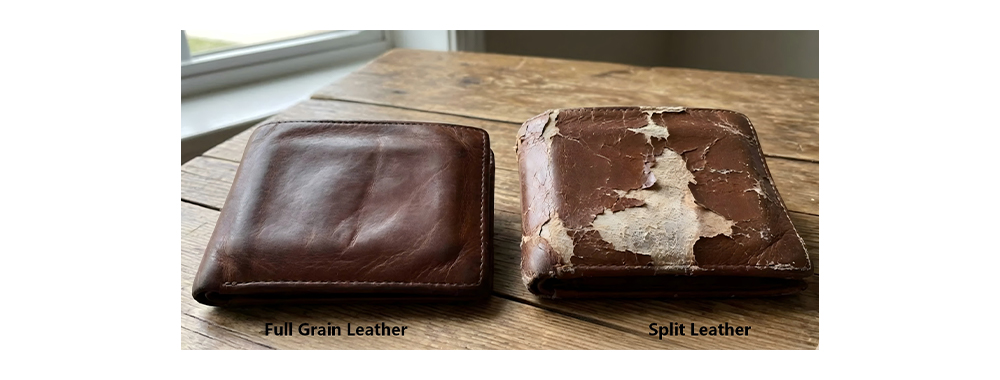
In high-stress areas such as bag handles and corners that undergo frequent bending, the dense and resilient fiber structure of top-grain leather makes it highly resistant to creasing and cracking. In contrast, the coated surface of split leather is more likely to peel, crack, or delaminate after repeated flexing.
Scratch Repairability:
Minor scratches on top-grain leather can often be reduced or blended with the application of leather conditioner or care oil. By comparison, once the coated surface of split leather is damaged, it is difficult—if not impossible—to restore its original appearance.
Aging Gracefully:
With regular use, top-grain leather develops a distinctive patina, a rich surface character that reflects the passage of time and adds uniqueness to each product. This natural aging process is often regarded as a hallmark of premium leather goods and a symbol of lasting quality. Split leather, on the other hand, is more prone to aging through fading, hardening, and surface deterioration rather than developing an attractive patina.
5. Cost & Pricing: The Difference Goes Beyond Raw Material Costs
In B2B custom manufacturing, the cost difference between top-grain leather and split leather extends far beyond the price of the leather itself.
| Cost Factor | Top-Grain Leather | Split Leather |
| Raw Material Cost | Higher (only one top-grain layer can be obtained from each hide) | Lower (multiple split layers can be produced from a single hide) |
| Material Utilization | Natural imperfections must be avoided during cutting, resulting in a utilization rate of approximately 70–80% | Fewer visible defects allow for a higher material utilization rate of approximately 85–95% |
| Manufacturing Process | Can retain its natural finish or require only light finishing; demands higher craftsmanship and stricter quality control | Typically requires coating or embossing; the production process is more standardized |
| Material Waste | Irregular natural grain patterns make cutting layouts less efficient, leading to higher material waste | Uniform surface texture allows for more efficient cutting layouts and better material utilization |
6. Custom Leather Bags: A B2B Buyer’s Decision Guide
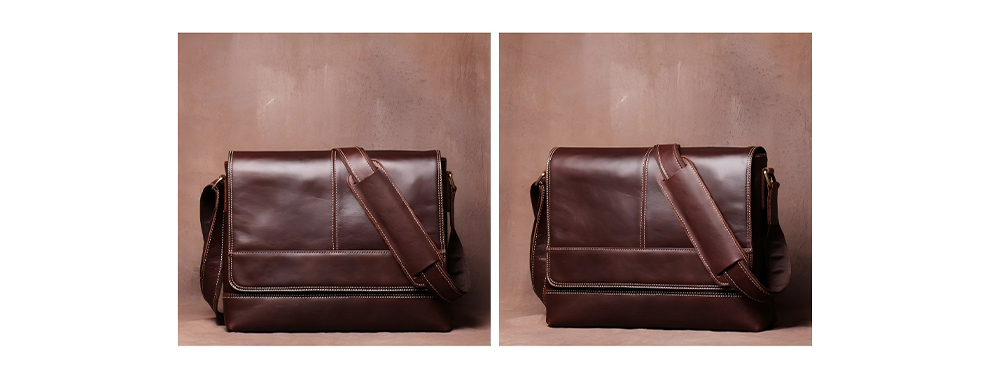
Choose Top-Grain Leather If:
- Your brand is positioned in the mid-to-high-end or luxury market and emphasizes heritage-quality craftsmanship and authentic leather character.
- Your products include business briefcases, premium travel bags, or limited-edition handbags, where durability and premium materials are key selling points.
- Your target customers are knowledgeable about leather and appreciate the uniqueness of natural grain, including minor scars, growth marks, and other natural characteristics.
- You aim to build long-term brand value and want your products to tell the story of “aging beautifully with use,” allowing the leather to develop a distinctive patina over time that enhances its appeal.
Choose Split Leather If:
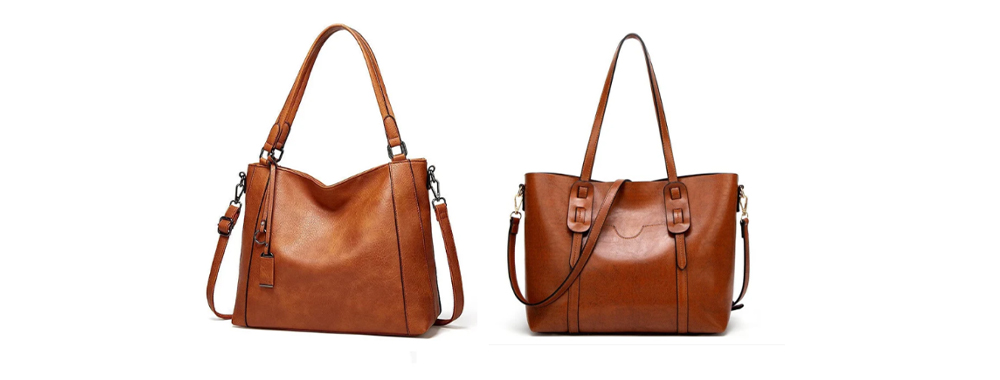
- Your brand focuses on cost-effectiveness and targets the price-sensitive mass market.
- Your project requires strict color consistency and uniform grain patterns, especially for large-volume production orders.
- Your budget is limited, but you still want to market the product as genuine leather.
- The expected product lifespan is 2–3 years, making it suitable for products that are not intended for long-term or lifetime use.
7. Common Misconceptions Clarified
Misconception 1: “Split Leather Isn’t Genuine Leather”
Reality:
Split leather is still genuine leather. The only difference is the layer of the hide from which it is derived. According to industry standards, it falls within the “Genuine Leather” category.
Misconception 2: “Top-Grain Leather Is Always Thicker Than Split Leather”
Reality:
Leather thickness is determined by the tanning and shaving (splitting) process, not by the leather grade itself. Top-grain leather can be processed into a soft, lightweight thickness of 0.8 mm, while split leather can also be manufactured at thicknesses of 2.0 mm or more.
Misconception 3: “Coated Split Leather Offers Better Water Resistance”
Reality:
A protective coating does improve the surface water resistance of split leather. However, once the coating is damaged, moisture can penetrate the looser fiber structure beneath the surface, making split leather more difficult to dry and maintain than top-grain leather.
8. FAQ: Common Questions About Custom Leather Bags
Q1: Is there any difference in environmental certifications between top-grain leather and split leather?
A:
Environmental performance depends on the tanning process (vegetable tanning / chrome tanning) and finishing chemicals, rather than the leather layer itself. If a brand requires certifications such as REACH, OEKO-TEX, or LWG, both types of leather can comply. However, it is necessary to request relevant test reports from suppliers.
Q2: How should we explain to end customers why a bag has natural scars?
A:
This is a “signature feature” of top-grain leather. It can be reframed as part of the brand storytelling:
“Each mark is a natural trace of the animal’s growth, ensuring that every bag is truly unique rather than a mass-produced duplicate.
Q3: Is top-grain leather suitable for printing or logo embossing?
A:
Yes, it is highly suitable. The dense fiber structure of top-grain leather allows debossing/embossing with sharp, well-defined edges and strong three-dimensional effects. Hot stamping (gold/silver foil) also adheres better compared to split leather. For split leather, temperature and pressure must be carefully controlled during logo embossing to avoid damaging the coating layer.
Q4: What materials are commonly used for coating split leather?
A:
Split leather coating processes generally fall into two main categories:
- PU transfer coating (most common): A polyurethane (PU) layer is first formed on release paper and then hot-pressed onto the leather surface.
- Direct coating: The coating is directly sprayed or roller-applied onto the split leather surface. Common materials include polyurethane (PU), acrylic resins, and nitrocellulose.
Q5: Will the coating on split leather peel off?
A:
Under normal use conditions, high-quality coatings can last 3–5 years. However, in environments with high temperature, high humidity, or frequent bending, adhesion may gradually weaken. PU coatings generally perform better than PVC in terms of durability, hand feel, and flexibility.
Q6: Do split leather and synthetic leather look the same?
A:
They can appear very similar visually, but clear differences remain upon closer inspection:
- Grain naturalness: Although both may be embossed, split leather still shows subtle irregularities in pattern depth and variation, making it closer to natural leather. Synthetic leather usually has overly uniform and repetitive grain patterns.
- Touch & resilience: Split leather feels more substantial and “meaty,” with slower rebound after pressing. It becomes softer with temperature changes. Synthetic leather feels smoother or more plastic-like, with quick rebound and minimal temperature sensitivity.
- Edge / cross-section: Split leather shows fibrous structure at the cut edge, even after finishing. Synthetic leather typically reveals a layered structure, such as a fabric base (nonwoven or woven) plus coating layers.
- Smell & aging behavior: Over 1–2 years of use, split leather may show coating cracking, peeling, or flaking, while the underlying natural leather fibers remain intact.